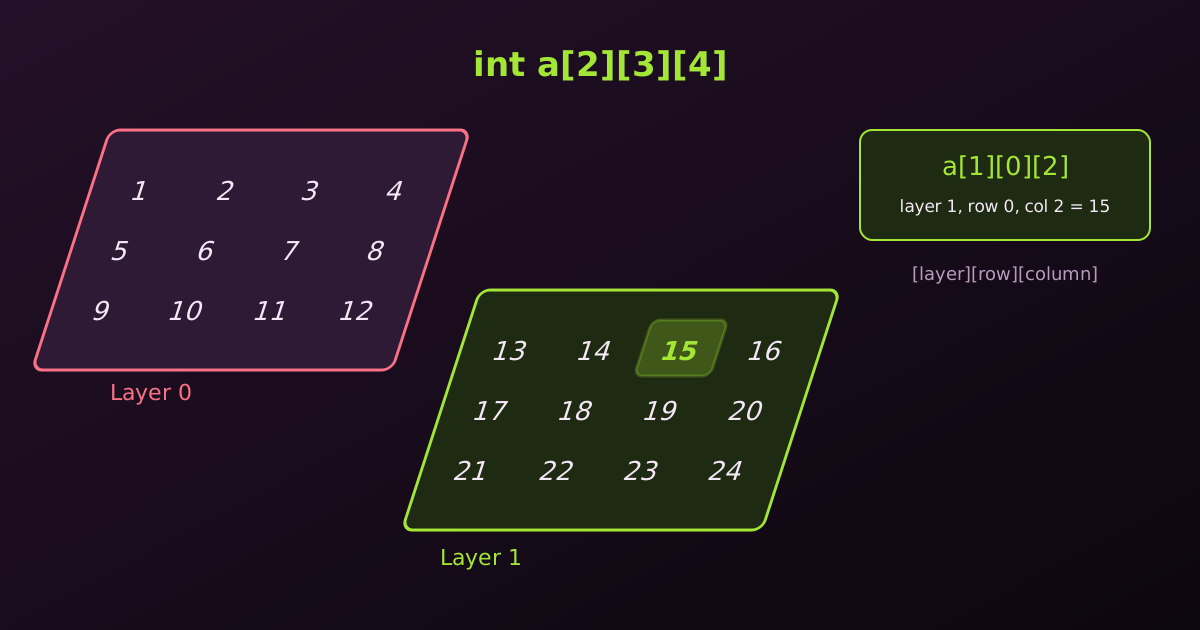
A 3D array in C is an array of matrices: a stack of 2D arrays. We can picture it as the pages of a book, where each page is a grid of rows and columns.
Here we create an array with 2 layers, 3 rows and 4 columns, fill it with the numbers 1 to 24, and print it layer by layer.
A complete example
#include <stdio.h>

int main() {
    // 1. Initialise a 3D array: [layers][rows][columns]
    int a[2][3][4] = {
        // Layer 0 (a 3 x 4 matrix)
        {
            {1, 2, 3, 4},
            {5, 6, 7, 8},
            {9, 10, 11, 12}
        },
        // Layer 1 (another 3 x 4 matrix)
        {
            {13, 14, 15, 16},
            {17, 18, 19, 20},
            {21, 22, 23, 24}
        }
    };

    // 2. Three nested loops, one per dimension
    for (int i = 0; i < 2; i++) {            // layers
        printf("--- Layer %d ---\n", i);

        for (int j = 0; j < 3; j++) {        // rows
            for (int k = 0; k < 4; k++) {    // columns
                printf("%4d", a[i][j][k]);
            }
            printf("\n");                    // end of a row
        }
        printf("\n");                        // blank line between layers
    }

    // 3. Read one element with three coordinates
    printf("a[1][0][2] = %d\n", a[1][0][2]);

    return 0;
}
Output:
--- Layer 0 ---
   1   2   3   4
   5   6   7   8
   9  10  11  12

--- Layer 1 ---
  13  14  15  16
  17  18  19  20
  21  22  23  24

a[1][0][2] = 15
Core ideas
- Declaration:
int a[layers][rows][columns];. The sizes in the example are 2, 3 and 4, so the array holds 2 × 3 × 4 = 24 integers. - Access: an element needs three coordinates, in the same order as the declaration.
a[1][0][2]is layer 1, row 0, column 2, which holds15. Like every C index, each one starts at 0. - Three loops: to visit every element we need three nested
forloops: the outer one over the layers, the middle one over the rows, and the inner one over the columns. The innermost index changes fastest, which is also how the numbers sit in memory. - Initialiser braces: each level of braces matches one dimension: the outer pair holds the layers, each layer holds its rows, and each row holds its columns. Missing values are filled with
0.
Tip
Printing one layer is exactly the 2D matrix printing we have already seen. The 3D version just repeats it once for every layer.