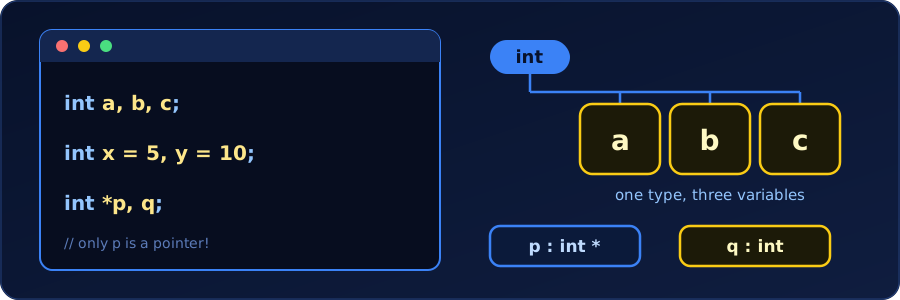
In C we can declare several variables in one statement by separating their names with commas. The only rule is that they share one type. All the code below was compiled with gcc -Wall -Wextra and the outputs are real.
1. Declare without initialising
int a, b, c;This creates three int variables. Their values are not defined yet, so we assign them before we read them:
#include <stdio.h>

int main(void) {
    int a, b, c;
    a = 1; b = 2; c = 3;
    printf("a=%d b=%d c=%d\n", a, b, c);
    return 0;
}
a=1 b=2 c=32. Declare and initialise each one
Every variable can get its own starting value, and a later one may use an earlier one in the same line:
int x = 10, y = 20, z = x + y;
double price = 9.99, tax = 0.15, total = price * (1 + tax);
printf("x=%d y=%d z=%d\n", x, y, z);
printf("total=%.2f\n", total);
x=10 y=20 z=30
total=11.49z = x + y works because x and y are already declared (and given values) by the time the compiler reaches z.
3. Give several variables the same value
Declare them first, then chain the assignment on the next line:
int i, j, k;
i = j = k = 0;
printf("i=%d j=%d k=%d\n", i, j, k);
i=0 j=0 k=0The assignment runs right to left: k = 0, then j = k, then i = j.
Writing it all in the declaration, int a = b = 5;, does not work. When the compiler reads b, it has not been declared yet:
error: 'b' undeclared (first use in this function)The valid forms are int a = 5, b = 5; or the two-line version above.
The traps
Partial initialisation
int a, b = 5;Only b is set to 5. The = belongs to one variable, not to the whole line. a holds whatever was in that memory before, and the compiler warns when we read it:
warning: 'a' is used uninitialized [-Wuninitialized]A common and harmless use is a loop counter, because the loop itself gives i its first value:
int i, sum = 0;
for (i = 0; i < 10; i++) {
    sum += i;
}
printf("sum = %d\n", sum);
sum = 45The asterisk belongs to the variable
int *r, s;Here r is a pointer to int, but s is a plain int. We can see the difference in their sizes:
int *r, s;
s = 4; r = &s;
printf("sizeof(r)=%zu sizeof(s)=%zu\n", sizeof(r), sizeof(s));
sizeof(r)=8 sizeof(s)=4(8 bytes is a pointer on a 64-bit machine.) Writing int* r, s; looks as if both are pointers, but it means exactly the same thing: only r is. To make both pointers we repeat the asterisk:
int *r, *s;If we later write p = q; with int *p, q;, gcc complains: assignment to ‘int *’ from ‘int’ makes pointer from integer without a cast. That message often means the asterisk trap.
Declarations can also mix a plain variable, an array and a pointer, since the extra symbols attach to each name:
int n = 7, arr[3] = {1, 2, 3}, *ptr = &n;
printf("n=%d arr[1]=%d *ptr=%d\n", n, arr[1], *ptr);
n=7 arr[1]=2 *ptr=7That compiles, but it is a good example of a line we would rather split.
You cannot mix base types
int a, float b;error: expected identifier or '(' before 'float'Each statement has one base type. Use two statements: int a; float b;.
Should we do it?
Both styles are correct. Many programmers keep one variable per line:
int count = 0;
int total = 0;
It is easier to comment each variable, simpler to read in a diff under version control, and it avoids the pointer and partial-initialisation traps. A single line is fine for closely related values of the same kind, such as int row, col; or double x = 0, y = 0;.
A modern alternative: declare in the loop
Since C99, a loop counter can be declared inside the for itself. It then exists only inside the loop and cannot leak out:
int sum = 0;
for (int i = 0; i < 10; i++) {
    sum += i;
}
Quick summary
| We want | Write | Remember |
|---|---|---|
| Several variables, no values | int a, b, c; |
Values are undefined until assigned |
| Different starting values | int x = 1, y = 2; |
Each = applies to one variable |
| Same starting value | int a = 0, b = 0; or int a, b; a = b = 0; |
int a = b = 0; is an error |
| Several pointers | int *p, *q; |
The * belongs to each name |
| Different types | Separate statements | One base type per declaration |