Five problems on nested loops (a loop inside a loop), from easy to medium. Try each one on paper or in your editor first. If we get stuck, open See hint for the steps, and press Reveal code to compare with a tested solution.
Every solution was compiled with gcc -Wall -Wextra and run; the outputs shown are real. For single-loop practice first, see 5 for loop practice problems.
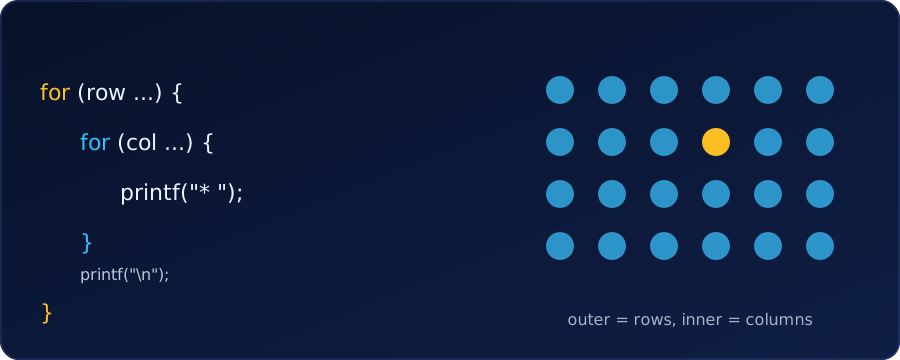
The grid recipe. For every pass of the outer loop, the inner loop runs from start to finish. So an outer loop over rows and an inner loop over columns visits every cell. Print the newline after the inner loop, once per row:
for (int row = 1; row <= R; row++) {
    for (int col = 1; col <= C; col++) {
        // print one cell
    }
    printf("\n");
}
Problem 1 (Easy): Rectangle of Stars
Print a rectangle of stars with 3 rows and 5 columns, using nested for loops. Put a space after each star.
Expected output:
* * * * *
* * * * *
* * * * * - The outer loop counts rows: 3 passes.
- The inner loop counts columns: 5 passes, each printing
"* ". - Print
"\n"after the inner loop, not inside it, or every star lands on its own line.
#include <stdio.h>

int main(void) {
    for (int row = 1; row <= 3; row++) {        // 3 rows
        for (int col = 1; col <= 5; col++) {    // 5 stars per row
            printf("* ");
        }
        printf("\n");                           // end the row
    }
    return 0;
}
Try next: let the user enter the number of rows and columns.
Problem 2 (Easy): Multiplication Grid
Print a 5 × 5 multiplication grid: the cell in row i, column j holds i * j. Align the columns.
Expected output:
   1   2   3   4   5
   2   4   6   8  10
   3   6   9  12  15
   4   8  12  16  20
5 10 15 20 25- Outer loop:
ifrom 1 to 5. Inner loop:jfrom 1 to 5. - Print
i * jfor each cell. - Use
%4dinstead of%d, which pads every number to 4 characters so the columns line up. - End each row with
"\n"after the inner loop.
#include <stdio.h>

int main(void) {
    for (int i = 1; i <= 5; i++) {
        for (int j = 1; j <= 5; j++) {
            printf("%4d", i * j);
        }
        printf("\n");
    }
    return 0;
}
Try next: make the grid 9 × 9 (what width do we need now?).
Problem 3 (Easy-Medium): Number Triangle
Print a triangle of numbers where row r holds the numbers 1 to r, with 5 rows.
Expected output:
1
1 2
1 2 3
1 2 3 4
1 2 3 4 5 - Outer loop:
rowfrom 1 to 5. - Row 1 has one number, row 2 has two, and so on, so the inner loop must stop at
row:col <= row. - Print
colfollowed by a space.
#include <stdio.h>

int main(void) {
    for (int row = 1; row <= 5; row++) {
        for (int col = 1; col <= row; col++) {
            printf("%d ", col);
        }
        printf("\n");
    }
    return 0;
}
The inner loop’s limit depends on the outer loop’s variable. That one detail turns a rectangle into a triangle. Print row instead of col and each line repeats its own row number (1, 22, 333, …).
Try next: print the triangle upside down (5 numbers first, then 4, …).
Problem 4 (Medium): Centred Pyramid
Print a pyramid of stars with 5 rows, centred: row 1 has 1 star, row 2 has 3, row 3 has 5, and so on.
Expected output:
    *
   ***
  *****
 *******
*********- An outer loop can hold two inner loops, one after the other.
- First inner loop: print spaces. Row 1 needs 4, row 2 needs 3, …, so
h - rowspaces. - Second inner loop: print stars. Rows need 1, 3, 5, …, so
2 * row - 1stars. - Then print
"\n".
#include <stdio.h>

int main(void) {
    int h = 5;
    for (int row = 1; row <= h; row++) {
        for (int s = 1; s <= h - row; s++) {        // leading spaces
            printf(" ");
        }
        for (int k = 1; k <= 2 * row - 1; k++) {    // stars: 1, 3, 5, ...
            printf("*");
        }
        printf("\n");
    }
    return 0;
}
Change h to change the size; the formulas still work.
Try next: print a diamond (this pyramid followed by an upside-down one).
Problem 5 (Medium): Checkerboard
Print a 6 × 6 checkerboard where # and . alternate in both directions, starting with # in the top-left corner.
Expected output:
# . # . # .
. # . # . #
# . # . # .
. # . # . #
# . # . # .
. # . # . # - Loop
rowandcolfrom 0 to 5. - Look at the corners:
#appears whererow + colis even,.where it is odd. - Test it with
(row + col) % 2 == 0and useif/elseto choose what to print.
#include <stdio.h>

int main(void) {
    for (int row = 0; row < 6; row++) {
        for (int col = 0; col < 6; col++) {
            if ((row + col) % 2 == 0) {
                printf("# ");
            } else {
                printf(". ");
            }
        }
        printf("\n");
    }
    return 0;
}
Whenever a pattern depends on a cell’s position, the trick is to find a formula in row and col.
Try next: print a border: # on the edges of an 8 × 8 square and spaces inside.
Debugging tip. If a pattern comes out wrong, check three things in order: (1) is the \n in the right loop, (2) is each inner loop’s limit what we intended (5, row, h - row), and (3) do the loops start at the value (0 or 1) our formula assumes?
What These Problems Practise
| Problem | Pattern |
|---|---|
| 1. Rectangle | Outer = rows, inner = columns, newline after the inner loop |
| 2. Multiplication grid | Using both loop variables in a calculation |
| 3. Number triangle | Inner limit depends on the outer variable |
| 4. Pyramid | Two inner loops in one outer loop |
| 5. Checkerboard | A formula in row and col plus an if |