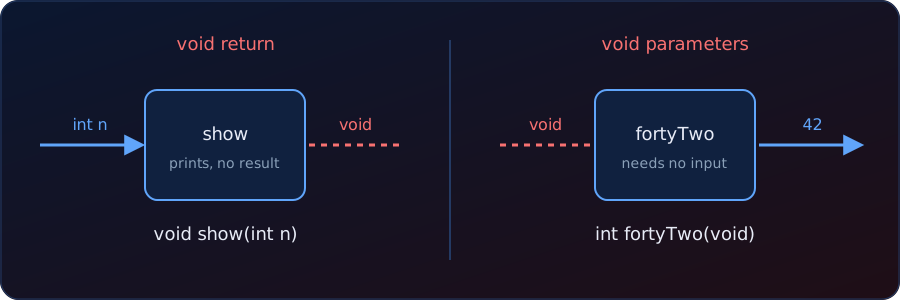
Consider this function:
int myFunction(int x) {
  return 5 + x;
}
It takes an argument and returns a value, so replacing either part with void would break it. void is for the other kinds of functions, and it means something different depending on where we write it.
The four combinations
int  myFunction(int x)   // takes an int, returns an int
int  myFunction(void)    // takes nothing, returns an int
void myFunction(int x)   // takes an int, returns nothing
void myFunction(void)    // takes nothing, returns nothing
Case 1: void as the return type
The function has no result. Its whole job is a side effect, such as printing, writing to a file, or changing an array in place.
void greet(int times) {
    for (int i = 0; i < times; i++)
        printf("Hello\n");
}
We call it as a statement. Nothing comes back, so there is nothing to pass to printf:
greet(3);                 // correct
printf("%d", greet(3));   // error: invalid use of void expression
A sorting function is a typical example:
void bubbleSort(int a[], int n); // sorts a[] in place, returns nothingThe array is changed through the pointer, so no return value is needed. Writing void documents that, and the compiler stops us from using a result that does not exist.
Case 2: void as the parameter list
int fortyTwo(void) {
    return 42;
}
Why not simply write int fortyTwo()? In C (before C23), empty parentheses mean unspecified arguments, which is the old pre-prototype style. The compiler does not check calls against it. The test below compiles without a single error:
int f();                       // unspecified parameters
int main(void) { return f(1, 2, 3); }   // accepted
With (void) the compiler enforces zero arguments:
int f(void) { return 7; }
int main(void) { return f(1); }
error: too many arguments to function ‘f’So int f(void) gives us type checking, which is the main reason to write it in C. In C++, and from C23 onward, f() and f(void) mean the same thing, but writing (void) is still correct and works with older compilers.
What void does to myFunction
| Change | Effect |
|---|---|
void myFunction(int x) |
printf("%d", myFunction(3)) no longer compiles. Call it as myFunction(3); instead. |
int myFunction(void) |
myFunction(3) is an error, since it now takes no arguments. |
void myFunction(void) |
Both the call and the printf break. |
Our function needs an input and produces an output, so void is the wrong tool for it.
All together
#include <stdio.h>

int  add(int a, int b)  { return a + b; }          // returns a value
void show(int n)        { printf("%d\n", n); }     // side effect only
int  fortyTwo(void)     { return 42; }             // takes nothing

int main(void) {
    printf("%d\n", add(2, 3));   // value used
    show(add(2, 3));             // value passed to a void function
    printf("%d\n", fortyTwo());  // called with no arguments
    return 0;
}
5
5
42show “just prints”, fortyTwo “takes nothing”, and main(void) “takes no command-line arguments”.
The rule. A void return means “call me for what I do, not for a value”. A void parameter list means “I take no arguments, and the compiler should enforce that”. If a function needs to take or give a value, use neither.