Complex numbers are the more natural choice whenever a problem involves rotations, oscillations, waves or roots of equations. Forcing a solution through real numbers alone needs messy trigonometry and heavy calculus, while complex numbers reduce the work to addition and multiplication. (If the basics are new, see Complex Numbers: Why They Are as Real as Real Numbers.)
Let’s go through six cases. In each we set the real-number approach beside the complex one.
1. Combining waves and oscillations
Real numbers: adding sound waves, light waves or alternating currents that start at different times (phases) needs trigonometric identities such as the one for \(\sin(A + B)\).
Complex numbers: write each wave as a complex number. Its length is the wave’s strength (amplitude) and its angle is the timing (phase). Adding waves is then just adding numbers.
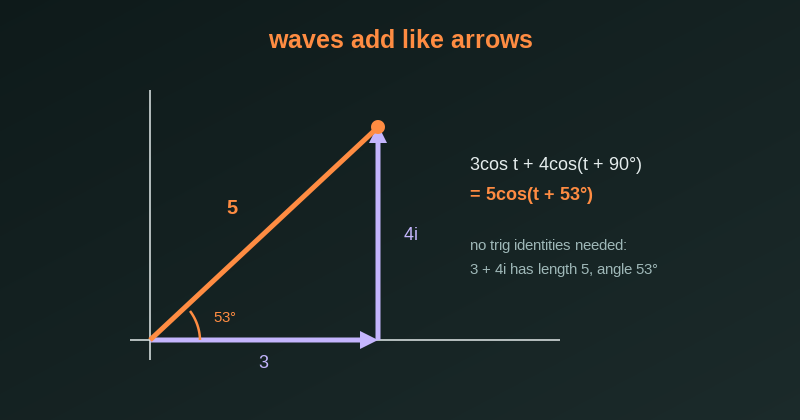
Example: add \(3\cos t\) and \(4\cos(t + 90^\circ)\). Represent them as \(3\) and \(4i\) (a quarter turn ahead):
\[ 3 + 4i \quad\Rightarrow\quad \text{length } \sqrt{3^2 + 4^2} = 5, \quad \text{angle } \tan^{-1}(4/3) \approx 53^\circ \]
So the combined wave is \(5\cos(t + 53^\circ)\), with no identities needed.
2. 2D rotations and geometry
Real numbers: rotating a point \((x, y)\) needs a \(2 \times 2\) matrix of sines and cosines.
Complex numbers: a point is one number, \(x + yi\), and rotating it is one multiplication. This makes complex numbers a natural choice for 2D physics engines and robotics.
Example: rotate \((1, 1)\) by 90 degrees. Multiply \(1 + i\) by \(i\):
\[ i(1 + i) = i + i^2 = -1 + i \]
so \((1, 1)\) moves to \((-1, 1)\).
3. Differential equations
Real numbers: equations for vibrating springs, shock absorbers and RLC circuits often have solutions that oscillate while dying away. With real numbers we must guess combinations of sines, cosines and exponentials.
Complex numbers: growth, decay and oscillation are all one exponential, \(e^{rt}\), with a complex \(r\). We just solve a quadratic.
Example: solve \(y'' + 2y' + 5y = 0\). Try \(y = e^{rt}\):
\[ r^2 + 2r + 5 = 0 \quad\Rightarrow\quad r = \frac{-2 \pm \sqrt{4 - 20}}{2} = -1 \pm 2i \]
The real part \(-1\) gives the decay (\(e^{-t}\)) and the imaginary part \(2\) gives the oscillation, so the solutions are \(e^{-t}\cos 2t\) and \(e^{-t}\sin 2t\). No guessing was needed.
4. Roots of polynomials
Real numbers: \(x^2 + 1 = 0\) has no solution, while \(x^2 - 1 = 0\) has two. The degree alone does not tell us how many roots to expect.
Complex numbers: they are algebraically closed: every polynomial of degree \(n\) has exactly \(n\) roots (counting repeats). This makes stability analysis in control theory predictable.
Example: \(x^3 - 1 = 0\) has a single real root, but three complex ones:
\[ x = 1, \qquad x = -\tfrac{1}{2} + \tfrac{\sqrt{3}}{2}\,i, \qquad x = -\tfrac{1}{2} - \tfrac{\sqrt{3}}{2}\,i \]
and \(x^2 + 1 = 0\) has the two roots \(\pm i\).
5. 2D fluid flow and electromagnetism
Real numbers: describing air flow around a wing, or an electric field around a wire, needs coupled partial differential equations in \(x\) and \(y\).
Complex numbers: complex functions preserve angles (conformal mapping). For ideal, frictionless flow, we can solve the easy case of flow around a circle, then use one complex function to bend the circle into another shape. The classic map \(w = z + 1/z\) turns a slightly off-centre circle into a wing-like profile, and the flow around the circle is carried along with it.
6. Hard real integrals
Real numbers: many integrals, especially in physics and statistics, have no elementary antiderivative, so ordinary calculus gets stuck.
Complex numbers: step into the complex plane and use the residue theorem. The answer is still a real number.
Example:
\[ \int_{-\infty}^{\infty} \frac{\cos x}{1 + x^2}\,dx = \frac{\pi}{e} \approx 1.156 \]
The trick is to replace \(\cos x\) by \(e^{iz}\) and to look at the function \(e^{iz}/(1 + z^2)\), which has a single trouble spot (a pole) at \(z = i\) in the upper half-plane. The residue theorem gives \(2\pi i \times \dfrac{e^{-1}}{2i} = \dfrac{\pi}{e}\), and the real part of that is the integral we wanted.
Summary
| Problem | Real-number approach | Complex approach |
|---|---|---|
| Adding waves | Trig identities | Add two numbers |
| 2D rotation | \(2 \times 2\) matrix | Multiply by \(e^{i\theta}\) |
| Oscillating, decaying solutions | Guess sines, cosines, exponentials | Solve a quadratic, read off \(r\) |
| Counting roots | Depends on the equation | Always exactly \(n\) |
| Flow around shapes | Coupled PDEs | Map a simple shape with one function |
| Hard integrals | No elementary antiderivative | Residues |
Key takeaway
- Whenever the problem involves a cycle, a rotation or a wave, complex numbers describe it directly.
- They do not replace real numbers: the final answers (amplitudes, positions, integrals) are still real. Complex numbers are the shortcut we take to reach them.