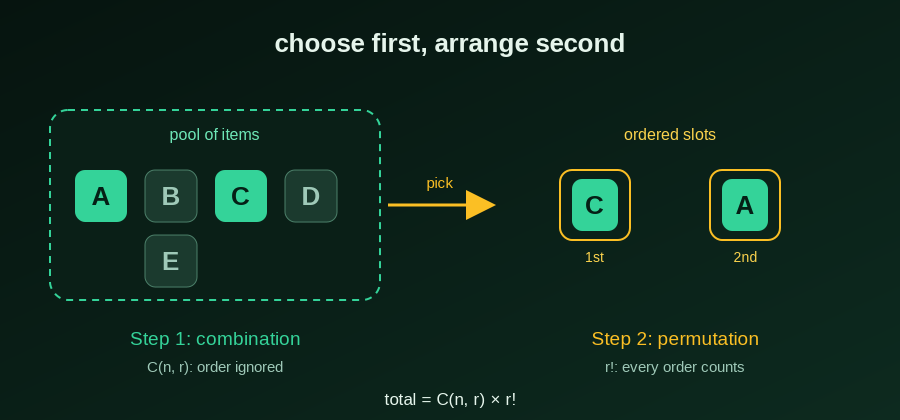
Permutations and combinations often appear in the same problem (if the two ideas are new, start with Understanding Permutations and Combinations with Examples). Whenever we must first select a group of items (a combination) and then arrange the chosen items in order (a permutation), we need both. This “choose first, arrange second” approach is the standard way to count when the items come from different categories.
\[ \text{total} = \underbrace{\binom{n}{r}}_{\text{choose the group}} \times \underbrace{r!}_{\text{order it}} \]
When there are several categories, Step 1 is a product of combinations, one per category, and \(r\) is the size of the whole chosen group.
1. Passwords with a fixed mix of characters
Suppose we want a 4-character password made of 2 distinct letters (from 26) and 2 distinct digits (from 10). A single permutation formula cannot guarantee the exact mix, so we fix the mix first.
- Step 1 (combination): choose the 2 letters and the 2 digits: \(\binom{26}{2} \times \binom{10}{2} = 325 \times 45 = 14{,}625\) groups.
- Step 2 (permutation): arrange the 4 chosen characters: \(4! = 24\) ways.
- Total: \(14{,}625 \times 24 = \mathbf{351{,}000}\) passwords.
2. Code words from separate pools
We have 6 consonants and 4 vowels, and we want a 5-letter code word with exactly 3 consonants and 2 vowels (no letter repeated).
- Step 1 (combination): \(\binom{6}{3} \times \binom{4}{2} = 20 \times 6 = 120\) ways to pick the letters.
- Step 2 (permutation): arrange the 5 letters: \(5! = 120\) orders.
- Total: \(120 \times 120 = \mathbf{14{,}400}\) words.
3. A batting order
A cricket squad has 15 players: 8 batsmen and 7 bowlers. The coach picks a starting 11 with 6 batsmen and 5 bowlers, then sets the batting order.
- Step 1 (combination): \(\binom{8}{6} \times \binom{7}{5} = 28 \times 21 = 588\) possible teams.
- Step 2 (permutation): put the 11 players in order from #1 to #11: \(11! = 39{,}916{,}800\) lineups.
- Total: \(588 \times 39{,}916{,}800 = 23{,}471{,}078{,}400 \approx \mathbf{2.35 \times 10^{10}}\) batting orders.
4. Seating guests on a stage
Twelve executives attend a conference, and 4 of them are chosen to sit in 4 labelled chairs on stage (Chair 1 to Chair 4).
- Step 1 (combination): choose the 4 executives: \(\binom{12}{4} = 495\) groups.
- Step 2 (permutation): assign the 4 chosen executives to the chairs: \(4! = 24\) ways.
- Total: \(495 \times 24 = \mathbf{11{,}880}\) ways.
Here nothing restricts who may sit where, so the two steps collapse into one:
\[ \binom{n}{r} \times r! = {}^{n}P_{r} = \frac{n!}{(n-r)!} \]
Indeed, \(^{12}P_4 = 12 \times 11 \times 10 \times 9 = 11{,}880\). The two-step method is needed when categories force a particular mix, as in the first three examples.
How to recognise these problems
| The question asks for… | Use |
|---|---|
| a group, order irrelevant | combination only |
| an ordered arrangement of everything or of \(r\) items from \(n\) | permutation only |
| a group with a required mix, and then an order | combination(s) first, then \(r!\) |
If the problem says “exactly \(k\) of this kind and \(m\) of that kind” and then asks for an arrangement, we are in the “choose first, arrange second” case.