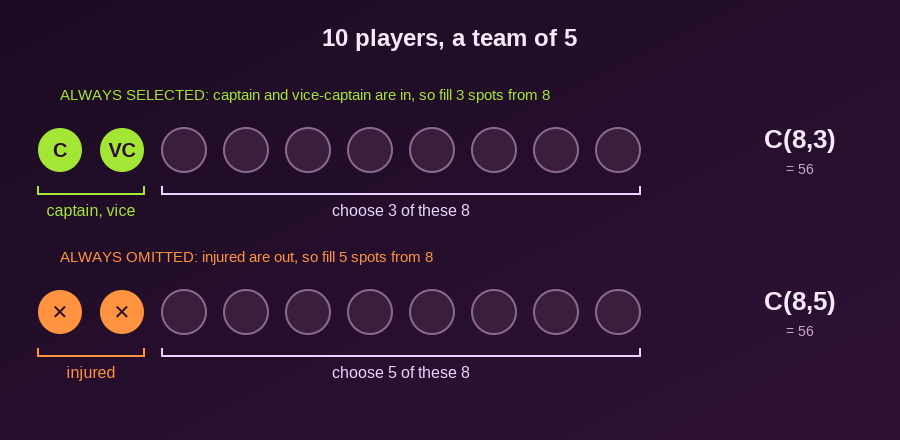
Choosing \(r\) items from \(n\) (see Understanding Permutations and Combinations with Examples for the basics) normally gives \(\binom{n}{r}\) ways. But what if \(p\) particular items must be included, or must not be? We start with a concrete team and let the logic show us the formula.
The situation
A coach must pick a team of \(r = 5\) players from a squad of \(n = 10\). Without any condition there are \(\binom{10}{5} = 252\) teams. Now we add a condition, in two different versions.
Case 1: some items are always selected
The captain and the vice-captain (\(p = 2\)) must both be on the team.
- The captain and vice-captain already hold 2 of the 5 spots, and their places are settled. They no longer take part in the choosing.
- The spots still open: \(5 - 2 = 3\).
- The players still available: \(10 - 2 = 8\) (everyone except the captain and vice-captain).
- So the only real decision is which 3 of the other 8 join them:
\[ \binom{8}{3} = \frac{8 \times 7 \times 6}{3 \times 2 \times 1} = \mathbf{56} \text{ ways.} \]
Case 2: some items are always omitted
Instead, 2 players (\(p = 2\)) are injured and must stay out.
- Injured players can never be picked, so we simply remove them from the squad: \(10 - 2 = 8\) players remain.
- Nothing has been filled, so all 5 spots are still open.
- The decision is which 5 of the healthy 8 play:
\[ \binom{8}{5} = \frac{8 \times 7 \times 6}{3 \times 2 \times 1} = \mathbf{56} \text{ ways.} \]
The two answers are equal here only by coincidence of the numbers: \(\binom{8}{3} = \binom{8}{5}\) because choosing 3 players to include is the same as choosing 5 to leave out. The two cases are different problems in general.
Deriving the general formulas
Replace the numbers by letters: \(n\) items, \(r\) to select, \(p\) special items.
Always selected. The \(p\) special items are placed, so we remove them from both the pool and the spots:
\[ \text{pool} = n - p, \qquad \text{spots} = r - p \quad\Longrightarrow\quad \boxed{\binom{n-p}{\,r-p\,}} \]
This needs \(p \le r \le n\): we cannot force in more items than there are spots.
Always omitted. The \(p\) special items leave the pool, but the spots are untouched:
\[ \text{pool} = n - p, \qquad \text{spots} = r \quad\Longrightarrow\quad \boxed{\binom{n-p}{\,r\,}} \]
This needs \(r \le n - p\): enough items must remain to fill every spot.
Summary
| Condition | Pool left | Spots left | Ways |
|---|---|---|---|
| \(p\) items always selected | \(n-p\) | \(r-p\) | \(\binom{n-p}{r-p}\) |
| \(p\) items always omitted | \(n-p\) | \(r\) | \(\binom{n-p}{r}\) |
In both cases the pool shrinks by \(p\). What differs is whether the spots shrink too: yes if the items are forced in, no if they are kept out.
Many textbooks write combinations as \(^{n}C_{r}\) or \(nCr\) instead of \(\binom{n}{r}\). All three mean the same thing, so the results above read equally well as \(^{n-p}C_{r-p}\) and \(^{n-p}C_{r}\).