Can a Discrete Variable Have Fractional Values? Examples
Yes. A variable is discrete when its possible values are separate and countable, even if they are fractions or decimals. Examples include shoe sizes, old stock prices, proportions of heads, and a comparison with continuous variables, with R.
R
Statistics
Author
Abdullah Al Mahmud
Published
November 4, 2026
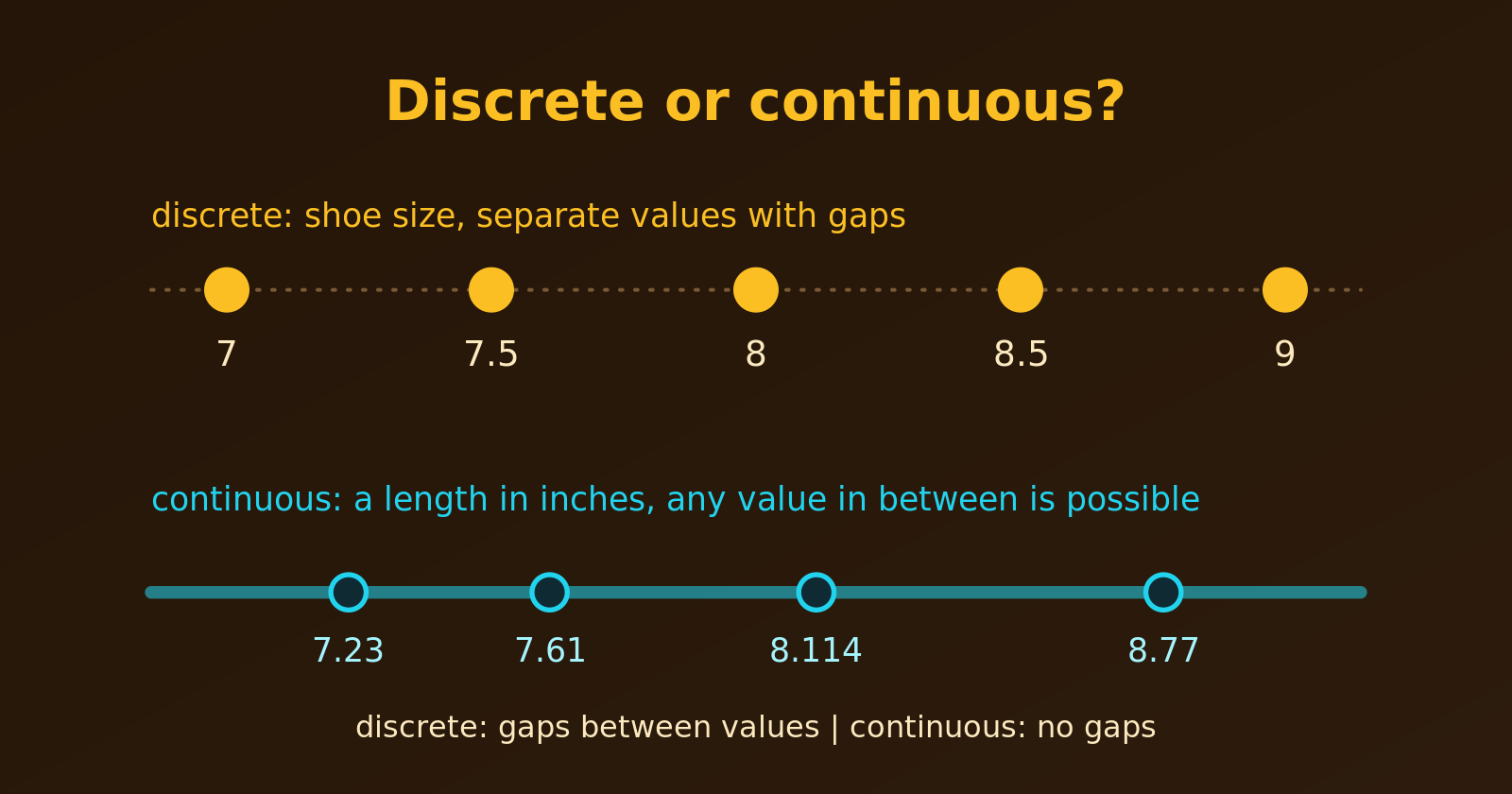
Discrete values are separate points with gaps; continuous values can be anywhere on the line.
Many people think that a discrete variable must be a whole number, like the number of children. That is not the definition. A variable is discrete if it takes distinct, isolated values that can be counted, so that there is a gap between any two neighbouring allowed values. Those values may well be fractions or decimals.
What matters is not whether the numbers are whole, but whether values between two neighbours are possible.
Examples of Discrete Variables with Fractional Values
Shoe sizes. We can buy size 8, 8.5, 9 or 9.5, in steps of 0.5. A size 8.23 does not exist, so the set of values is separate and countable.
Stock prices before decimalisation. Before 2001, US stock exchanges quoted prices in fractions such as \(\frac{1}{8}\) or \(\frac{1}{16}\) of a dollar (for example \(10\frac{1}{8}\) or \(10\frac{1}{4}\)). A price between two fractions was not allowed.
Pre-decimal British money. Before 1971, coins included the halfpenny (\(\frac{1}{2}\)d) and the farthing (\(\frac{1}{4}\)d). Prices moved in these fixed fractional steps.
Measuring cups. A standard set has \(\frac{1}{4}\), \(\frac{1}{3}\), \(\frac{1}{2}\) and 1 cup. The capacity we can measure with one cup jumps from one of these fractions to the next.
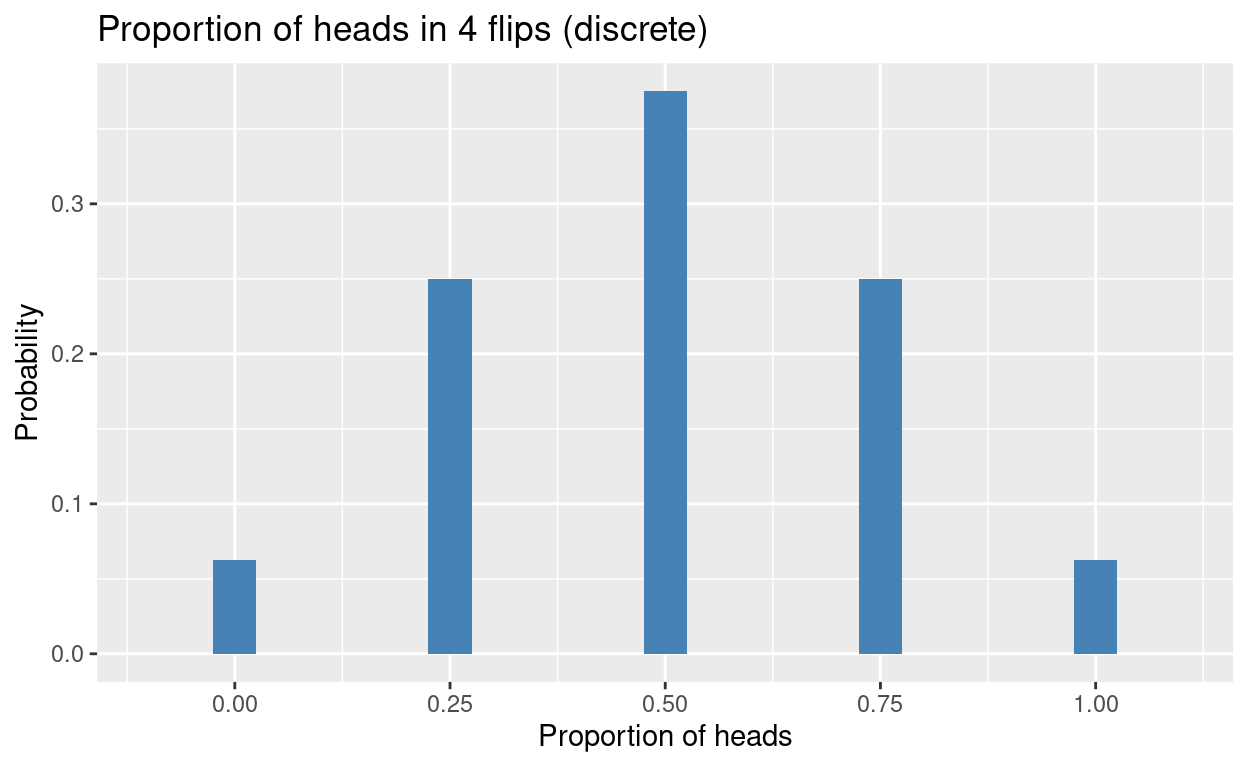
Proportions with a fixed denominator. If we flip a coin 4 times, the proportion of heads can only be \(0\), \(0.25\), \(0.5\), \(0.75\) or \(1\). A value like \(0.33\) is impossible, because the denominator is fixed by \(n = 4\).
Seeing the Last Example in R
For 4 coin flips, the number of heads follows a binomial distribution. Here are the probabilities of each possible proportion. The bars are separated, with nothing in between.
ggplot(flips, aes(proportion, probability)) +geom_col(width =0.05, fill ="steelblue") +scale_x_continuous(breaks = flips$proportion, limits =c(-0.1, 1.1)) +labs(title ="Proportion of heads in 4 flips (discrete)",x ="Proportion of heads", y ="Probability")
Only five proportions can occur. If we had measured something continuous, such as the exact height of 4 people, any value in a range would be possible and the bars would merge into a curve.
Discrete or Continuous?
A useful test: can we always find another possible value between two given values? If yes, the variable is continuous. If no, it is discrete.
Variable type
Value examples
Countable and isolated?
Discrete (whole numbers)
1 child, 2 cars, 3 books
Yes
Discrete (fractional)
Size 7.5, size 8, size 8.5
Yes
Continuous
7.523 inches, 8.114 seconds
No: infinitely many values between any two
Note
Measurements are often recorded in a discrete way. A person’s height is continuous, but when we write it to the nearest centimetre, the recorded values are discrete. It is the variable itself, not its rounding, that decides the type, so we classify height as continuous.
Summary
A discrete variable has separate, countable values with gaps between them.
Discrete does not mean whole numbers: shoe sizes, old stock prices and proportions of \(n\) trials are all discrete fractions.
A variable is continuous when any value in a range is possible, with no gaps.