R, like C and Python, supports recursion: a function can call itself, directly or through another function. Every recursive function needs two parts:
- a base case that returns an answer without calling itself, so the process stops;
- a recursive case that calls the function again on a smaller problem.
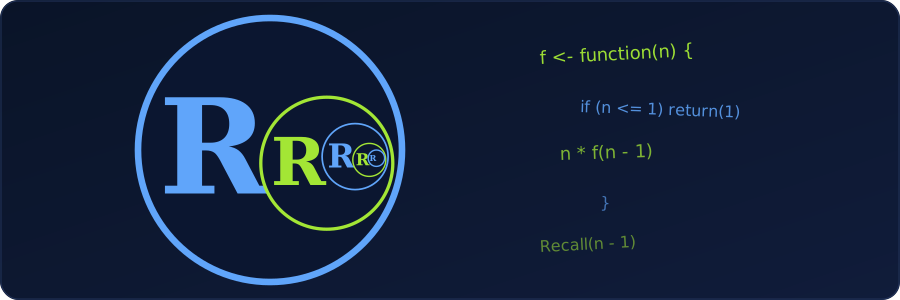
A basic example
factorial_rec <- function(n) {
  if (n <= 1) return(1)        # base case
  n * factorial_rec(n - 1)     # recursive case
}

factorial_rec(5)
[1] 120The call for 5 waits for the call for 4, which waits for the call for 3, and so on. At n = 1 the base case answers, and the results multiply on the way back.
Indirect recursion
Two functions can call each other. Here is_even() and is_odd() take turns until n reaches 0:
is_even <- function(n) {
  if (n == 0) return(TRUE)
  is_odd(n - 1)
}

is_odd <- function(n) {
  if (n == 0) return(FALSE)
  is_even(n - 1)
}

is_even(10)
[1] TRUERecall(): recursion without the function’s name
Recall() calls the function that is currently running. It helps for anonymous functions, or when we rename a function later and do not want to edit the body:
fib <- function(n) {
  if (n <= 1) return(n)
  Recall(n - 1) + Recall(n - 2)
}

fib(10)
[1] 55Recursion on nested lists
Lists can hold other lists, and recursion follows that shape naturally. This function counts how deeply a list is nested:
depth <- function(x) {
  if (!is.list(x)) return(0)           # not a list: depth 0
  if (length(x) == 0) return(1)        # empty list: avoid max() of nothing
  1 + max(vapply(x, depth, numeric(1)))
}

depth(list(1, list(2, list(3))))
[1] 3The outer list, the list holding 2, and the list holding 3 make three levels. Without the empty-list check, depth(list()) would warn and return -Inf, because max() of nothing has no answer.
Limits in R
R does not optimise tail calls, so every call stays on the stack until the whole chain finishes. Deep recursion can fail.
Let’s count down from n with a recursive function and see how deep we can go on a default R session:
f <- function(n) if (n == 0) 0 else 1 + f(n - 1)

f(1000)
f(5000)
[1] 1000
Error: evaluation nested too deeply: infinite recursion / options(expressions=)?Three limits matter.
The expressions limit
R caps how deeply expressions nest. The default is 5000, and we can raise it (up to 500000):
options(expressions = 50000)
f(5000)
[1] 5000The stack limit
Raising expressions only moves the wall. On our machine, f(20000) then fails with node stack overflow. A different error, C stack usage is too close to the limit, can also appear. Both come from fixed memory limits, and the exact depth depends on the system.
Speed
Function calls cost more than loop steps. Naive fib(25) took roughly 0.1 to 0.2 seconds here, and each extra step makes it about 1.6 times slower, because the same values are computed again and again.
Memoisation
Caching results fixes the repeated work. The memoise package (install it with install.packages("memoise")) wraps a function so each answer is computed once:
library(memoise)

fib_fast <- memoise(function(n) {
  if (n <= 1) return(n)
  fib_fast(n - 1) + fib_fast(n - 2)
})

fib_fast(40)
[1] 102334155Without the cache, the same call would repeat hundreds of millions of steps.
When a loop is better
For simple repeated work, a loop is faster and has no depth limit:
fib_loop <- function(n) {
  a <- 0
  b <- 1
  for (i in seq_len(n)) {
    next_value <- a + b
    a <- b
    b <- next_value
  }
  a
}

fib_loop(40)
[1] 102334155Reduce() is another option for folds, for example Reduce("*", 1:5) gives 120, the same as factorial_rec(5).
When recursion fits
Recursion is a good choice when the problem is naturally recursive:
- walking nested lists or JSON-like data;
- working with trees (for example from
rpartordata.tree); - going through R’s own code (language objects);
- divide-and-conquer methods such as merge sort and quicksort.
Rule of thumb: use recursion when it makes the code clearer. Switch to a loop when the depth may pass about 1000, when speed matters, or when we hit the expressions or stack limits above.