This post is an English retelling, with additions, of the Bengali article “পরিসংখ্যানিক পিতা!” by Dr. Rahmatullah Imon, shared on the earlier Stat Mania blog with his permission. The case details and the study figures below come from Dr. Imon’s account unless another source is named.
Before DNA tests existed, a court that doubted a child’s father had very little to go on. One of the most striking answers came from statistics: if a pregnancy lasted too long, the husband could not be the father. But how long is too long? A bell curve helped answer that.
A Baby Born 349 Days Later
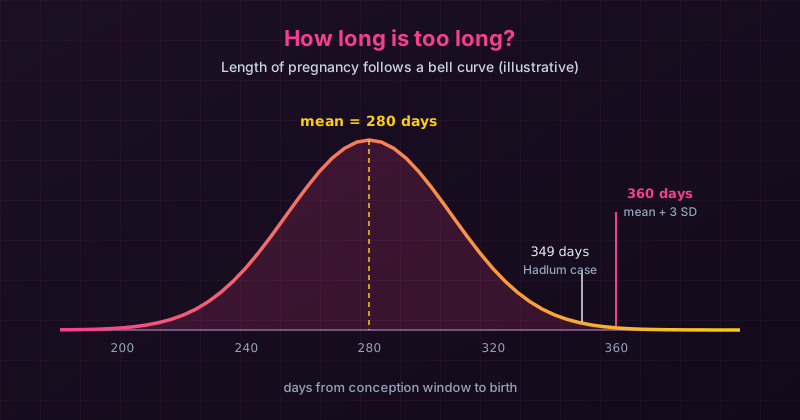
In the late 1940s a British soldier, Major Hadlum, returned from the war to find that his wife had given birth to a child. Counting from the day he left, the baby arrived 349 days later. A normal pregnancy lasts about 280 days (40 weeks), so Hadlum suspected his wife had been unfaithful and petitioned for divorce on that ground.
The court held that such a long pregnancy was unusual but possible, so adultery was not proven. This was Hadlum v Hadlum, decided in 1948 and upheld on appeal in 1949.
Why a Single Number Is Not Enough
Other cases followed with gaps of around 340 and 360 days, and the judges had no agreed way to decide them. “Impossible” is a strong word for a biological process, since gestation length varies from one pregnancy to the next. What the courts needed was a cut-off, a point beyond which an outcome is so unlikely that we treat it as an outlier.
The Bell Curve Draws the Line
Gestation length is well described by a normal distribution centred near 280 days. The empirical rule says that about 99.7% of values lie within three standard deviations of the mean. Dr. Imon reports a large British study of more than 13,000 pregnancies that supported this shape, and that applying “mean + 3 SD” put the upper limit at roughly 360 days. (We could not independently confirm the details of that study, so treat its numbers as Dr. Imon’s account.)
Working backwards from the 360-day limit gives a standard deviation of about 27 days. We can check the arithmetic in R:
m <- 280
s <- 80 / 3                      # (360 - 280) / 3, about 26.7 days

pnorm(c(349, 360), m, s, lower.tail = FALSE)
[1] 0.00483 0.00135So under this model, only about 0.5% of pregnancies run past 349 days, and about 0.14% past 360. Hadlum’s case sat at 2.6 standard deviations above the mean, rare but not impossible, while 360 days sits exactly at 3.
The model is a simplification. Modern studies find that natural gestation varies more widely than the 280-day textbook figure suggests, and the distribution is not perfectly symmetric. The curve above is illustrative, not a medical reference.
The Court Draws a Line
In Preston-Jones v Preston-Jones, a husband had been abroad for about six months, and his wife’s child was born roughly 360 days after the last time they could have met. The trial judge refused the divorce, but the House of Lords, in a decision of December 1950 (reported in 1951), directed that the husband’s petition be allowed. One judge in the case had argued that a court should not accept such a pregnancy as possible without direct medical evidence.
It is common to read this as a rule that any child born within 360 days must be the husband’s. That is a simplification: the Lords decided one case on its evidence, and the 360-day figure became a practical benchmark rather than a statute. Even so, the idea behind it is a lesson in statistics. A “three-sigma” limit turned a vague legal question into a measurable one, and fathers in such cases were sometimes called “statistical fathers”.
What We Can Take from This
- Outliers are judged against a distribution. A value of 349 days means little until we know the mean and spread of the data.
- The three-sigma rule is a convention. Moving the cut-off to 2.5 or 4 standard deviations changes who is classed as an outlier.
- Rare is not impossible. A statistical limit measures how surprising a value is, which is different from proving what happened in one real case.
References and Further Reading
- Imon, R. (2017). পরিসংখ্যানিক পিতা! (Statistical Father!). Stat Mania (Bengali), 16 September 2017. The main source for this post.
- McKenzie, D. (2014). Statistical outliers: of baldness and long gestations. Discusses Hadlum v Hadlum and the 360-day limit.
- Preston-Jones v Preston-Jones, House of Lords, 14 December 1950; reported at [1951] AC 391.