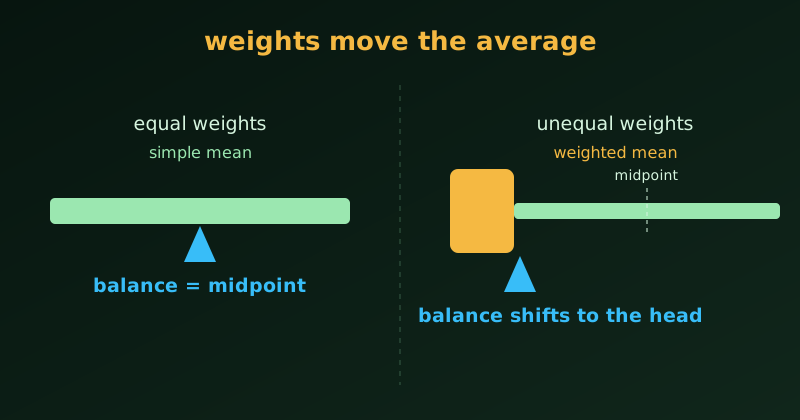
Starting with the simple mean
Let’s consider this data:
2, 4, 6The arithmetic mean is 4, since (2 + 4 + 6) / 3 = 4. Here every value counts equally.
When values are not equally important
Now let’s say these are marks given by three judges to a participant in a competition. The first judge is more experienced, so whatever that judge gives should carry more weight. We multiply each mark by a weight:
| Judge | Mark (\(x\)) | Weight (\(w\)) |
|---|---|---|
| 1 | 2 | 2 |
| 2 | 4 | 1.5 |
| 3 | 6 | 1 |
The average now tilts toward the marks with more weight. Like a hammer, more weight on one side shifts the centre of gravity.
The formula
The weighted average is the sum of each value times its weight, divided by the sum of the weights:
\[ \bar{x}_w = \frac{\sum_{i=1}^{n} w_i x_i}{\sum_{i=1}^{n} w_i} \]
Dividing by the total weight keeps the result on the same scale as the data. If all weights are equal, it reduces to the ordinary mean.
Example 1: the judges
| Judge | Mark (\(x\)) | Weight (\(w\)) | \(w \times x\) |
|---|---|---|---|
| 1 | 2 | 2 | 4 |
| 2 | 4 | 1.5 | 6 |
| 3 | 6 | 1 | 6 |
| Total | 4.5 | 16 |
\[ \bar{x}_w = \frac{2 \times 2 + 4 \times 1.5 + 6 \times 1}{2 + 1.5 + 1} = \frac{4 + 6 + 6}{4.5} = \frac{16}{4.5} \approx 3.56 \]
The weighted average (3.56) is lower than the simple mean (4), because the lowest mark came from the most trusted judge.
Example 2: course grades
A student scores 90 in Math (4 credits), 80 in English (3 credits) and 70 in Art (2 credits). The simple mean is 80, but a 4-credit course should count more than a 2-credit one.
| Course | Score (\(x\)) | Credits (\(w\)) | \(w \times x\) |
|---|---|---|---|
| Math | 90 | 4 | 360 |
| English | 80 | 3 | 240 |
| Art | 70 | 2 | 140 |
| Total | 9 | 740 |
\[ \bar{x}_w = \frac{90 \times 4 + 80 \times 3 + 70 \times 2}{4 + 3 + 2} = \frac{360 + 240 + 140}{9} = \frac{740}{9} \approx 82.22 \]
The weighted average is higher than the simple mean, since the best score sits in the heaviest course.
Weights need not add up to 1 or 100. Dividing by \(\sum w\) takes care of that. If they do sum to 1 (for example 0.5, 0.3, 0.2), the denominator is 1 and the average is just \(\sum w_i x_i\).
Key takeaway
- Use the simple mean when every value is equally important.
- Use a weighted average when some values matter more (expert judges, credit hours, group sizes).
- The result always lies between the smallest and largest value, pulled toward the heaviest weights.