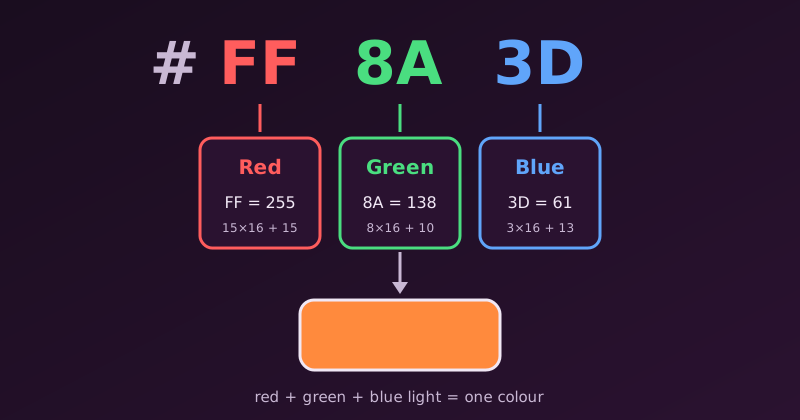
A hex color code is a six-character string used in web design (and in many other tools) to tell a screen how much red, green and blue (RGB) light to mix. It always starts with a hash sign, #.
Anatomy of a Hex Code
The six characters split into three pairs, and each pair controls one colour channel:
| Pair | Channel | In #RRGGBB |
|---|---|---|
| First | Red | RRGGBB |
| Second | Green | RRGGBB |
| Third | Blue | RRGGBB |
How the Base-16 System Works
Hexadecimal is a base-16 number system. Decimal counts 0 to 9 before rolling over; hexadecimal keeps going to 16 symbols by using the letters A to F for the values 10 to 15:
| Hex digit | 0–9 | A | B | C | D | E | F |
|---|---|---|---|---|---|---|---|
| Value | 0–9 | 10 | 11 | 12 | 13 | 14 | 15 |
F is the largest value a single digit can have. A pair therefore runs from 00 (channel off, decimal 0) to FF (full intensity, decimal 255).
Converting a pair to 0–255
- Multiply the first character by 16.
- Multiply the second character by 1.
- Add the two results.
Example: FF. F is 15, so (15 × 16) + 15 = 240 + 15 = 255.
Example: A3. A is 10, so (10 × 16) + 3 = 160 + 3 = 163.
Now we can read the code from the figure, #FF8A3D:
| Channel | Pair | Calculation | Value |
|---|---|---|---|
| Red | FF |
15 × 16 + 15 | 255 |
| Green | 8A |
8 × 16 + 10 | 138 |
| Blue | 3D |
3 × 16 + 13 | 61 |
That is a strong red, a medium green and a little blue, which gives the orange in the figure.
Checking It in R
R programming language understands hex colours, so we can confirm the conversion with col2rgb():
col2rgb("#FF8A3D") [,1]
red 255
green 138
blue 61And rgb() goes the other way, from numbers to a hex code:
rgb(255, 138, 61, maxColorValue = 255)[1] "#FF8A3D"Hex is only one way to write the same numbers. RGB Color Codes Explained covers the decimal form, rgb(255, 138, 61), and rgba() for transparency.
Common Examples
| Colour | Code | Meaning |
|---|---|---|
| Pure red | #FF0000 |
Max red, no green, no blue |
| Pure green | #00FF00 |
No red, max green, no blue |
| Pure blue | #0000FF |
No red, no green, max blue |
| White | #FFFFFF |
All channels at maximum |
| Black | #000000 |
All channels off |
| Grey | #787878 |
Equal values in all three pairs |
Any code whose three pairs are identical is a shade of grey. For #787878, each pair is 7 × 16 + 8 = 120.
Hex codes follow an additive light model: higher values make a colour brighter and closer to white, not darker as with paint.
Handy Variations
- Short form: when each pair has two identical digits, it can be shortened to three, so
#FF0000becomes#F00. - With transparency: an eight-character code adds a fourth pair for opacity, as in
#FF8A3D80(about 50%).
References
- Hex color codes, GeeksforGeeks
- How hex code colors work, freeCodeCamp
- Understanding hexadecimal colors, Pluralsight
- Hex colour codes explained, Corey Ginnivan
- ELI5: how hex code works, r/explainlikeimfive