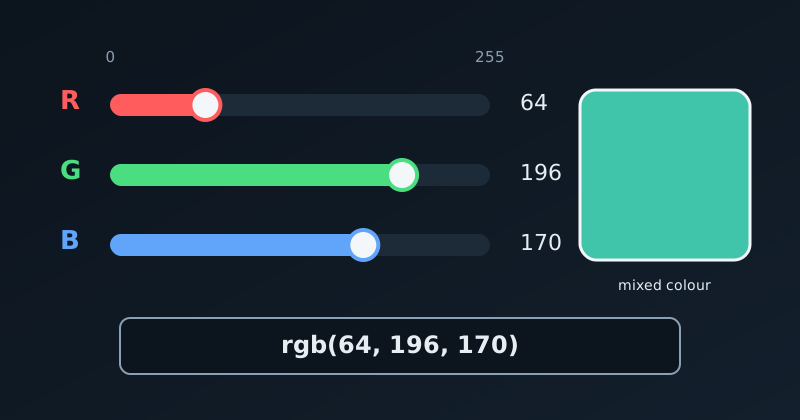
An RGB color code tells a digital screen exactly how much red, green and blue light to mix to make a colour. A hex code writes the same three amounts in base 16. An RGB code writes them as ordinary decimal numbers from 0 to 255.
The Anatomy of an RGB Code
An RGB code is written like a function with three numbers in parentheses:
rgb(Red, Green, Blue)0means the channel is completely off (no light).255means the channel is at full intensity.
Screens create colour by adding light (the additive colour model), and three channels with 256 levels each give 256 × 256 × 256 = 16,777,216 possible colours.
RGB vs Hex
An RGB code uses the same numbers we get when converting each pair of a hex code. Here are the basic colours in both forms:
| Colour | Hex | RGB | Why |
|---|---|---|---|
| Pure red | #FF0000 |
rgb(255, 0, 0) |
Full red, no green, no blue |
| Pure green | #00FF00 |
rgb(0, 255, 0) |
No red, full green, no blue |
| Pure blue | #0000FF |
rgb(0, 0, 255) |
No red, no green, full blue |
| Black | #000000 |
rgb(0, 0, 0) |
All lights off |
| White | #FFFFFF |
rgb(255, 255, 255) |
All lights at full intensity |
In the hex post we worked out that the pair A3 equals 10 × 16 + 3 = 163. So the hex code #A30000 is the same colour as rgb(163, 0, 0).
Converting in R
R can move between the two forms. col2rgb() turns a hex code into RGB numbers:
col2rgb("#40C4AA") [,1]
red 64
green 196
blue 170and rgb() turns RGB numbers into a hex code:
rgb(64, 196, 170, maxColorValue = 255)[1] "#40C4AA"What Is RGBA?
Sometimes a fourth number is added: rgba(Red, Green, Blue, Alpha). The alpha channel sets transparency, on a scale from 0.0 to 1.0:
0.0: completely invisible0.5: half see-through1.0: completely solid
For example, this gives a vibrant blue that lets whatever is behind it show through:
rgba(0, 0, 255, 0.5)In hex, alpha becomes an extra pair at the end. In R, rgb() takes an alpha argument on a 0 to 1 scale and reproduces it:
rgb(0, 0, 1, alpha = 0.5)[1] "#0000FF80"The 80 is 0.5 × 255 rounded to 128, which is 80 in hex.
See Also
- Hex Color Codes Explained: the base-16 form and how to convert a pair by hand.