Recursion means a function solves a problem by calling itself on a smaller version of that problem. Let’s look at a simple example, sum(n), the sum of the first n integers, and trace sum(3) step by step:
GOING DOWN                              RETURNING UP
sum(3) = 3 + sum(2)              ──┐
sum(2) = 2 + sum(1)              ──┤    sum(0) = 0                (base hit)
sum(1) = 1 + sum(0)              ──┤    sum(1) = 1 + 0 = 1
sum(0) = 0   ← base              ──┘    sum(2) = 2 + 1 = 3
                                        sum(3) = 3 + 3 = 6
Each call waits for the one below it, and the additions can only happen on the way back up, once sum(0) has returned.
This is a textbook recursion example. It has the three things every recursive function needs:
- A base case that stops the recursion —
sum(0) = 0. Without this, it would callsum(-1),sum(-2), … forever (stack overflow). - A recursive case that shrinks the problem —
sum(3)callssum(2), which callssum(1)… each call gets closer to the base case. - The “unwinding” — once
sum(0)returns0, the answers flow back up:1+0=1,2+1=3,3+3=6.
That “go down, hit bottom, come back up” shape is the heart of all simple recursion. In C, sum looks like this:
#include <stdio.h>

int sum(int n) {
    if (n == 0) return 0;     // BASE CASE
    return n + sum(n - 1);    // RECURSIVE CASE
}

int main(void) {
    printf("%d\n", sum(3));   // 6
    return 0;
}
Another example: factorial, with full step trace
factorial(n) = n × (n-1) × … × 1, and factorial(0) = 1 by definition (the base case).
#include <stdio.h>

long factorial(int n) {
    if (n == 0) {          // BASE CASE: stop here
        return 1;
    }
    return n * factorial(n - 1);   // RECURSIVE CASE: shrink n
}

int main(void) {
    for (int i = 0; i <= 5; i++)
        printf("%d! = %ld\n", i, factorial(i));
    return 0;
}
Compile and run (gcc factorial.c -o factorial && ./factorial; see Compiling and Running C Programs on Linux for faster workflows):
0! = 1
1! = 1
2! = 2
3! = 6
4! = 24
5! = 120
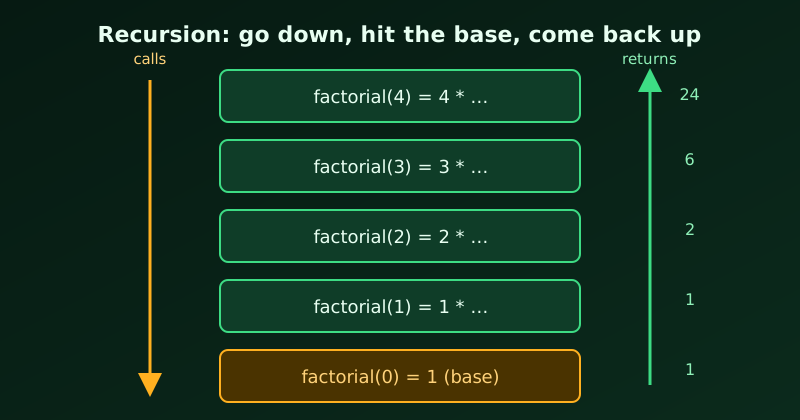
Step-by-step trace of factorial(4)
GOING DOWN                              RETURNING UP
factorial(4) = 4 * factorial(3)  ──┐
factorial(3) = 3 * factorial(2)  ──┤    factorial(0) = 1          (base hit)
factorial(2) = 2 * factorial(1)  ──┤    factorial(1) = 1 * 1 = 1
factorial(1) = 1 * factorial(0)  ──┤    factorial(2) = 2 * 1 = 2
factorial(0) = 1   ← base        ──┘    factorial(3) = 3 * 2 = 6
                                        factorial(4) = 4 * 6 = 24
Notice the multiplication can’t happen until the call below returns ; that’s why the result is computed on the way back up, not on the way down. This is the same shape as the sum example.
Same skeleton, side by side
sum(n) |
factorial(n) |
|
|---|---|---|
| Base case | n == 0 → 0 |
n == 0 → 1 |
| Recursive case | n + sum(n-1) |
n * factorial(n-1) |
| How it shrinks | n → n-1 |
n → n-1 |
| Combines results by | + |
* |
The only real difference is what operator you apply when coming back up. Recursion’s structure is remarkably reusable — change the base value and the operator, and you get a whole family of functions.
A second example where recursion branches: power
Simple linear recursion calls itself once per step (like sum and factorial). A more interesting form calls itself and combines — here, power computes x^n fast by halving n:
#include <stdio.h>

double power(double x, int n) {
    if (n == 0) return 1.0;                 // BASE: x^0 = 1
    if (n < 0)  return 1.0 / power(x, -n);  // handle negatives
    if (n % 2 == 0) {                       // even n: x^n = (x^(n/2))^2
        double half = power(x, n / 2);
        return half * half;
    }
    return x * power(x, n - 1);             // odd n: peel one off
}

int main(void) {
    printf("%.0f\n", power(2, 10));   // 1024
    printf("%.0f\n", power(3, 4));    // 81
    return 0;
}
Trace of power(2, 10):
power(2,10) → half = power(2,5); return half*half
  power(2,5) → return 2 * power(2,4)
    power(2,4) → half = power(2,2); return half*half
      power(2,2) → half = power(2,1); return half*half
        power(2,1) → return 2 * power(2,0)
          power(2,0) → 1                       (base)
        power(2,1) → 2 * 1 = 2
      power(2,2) → 2 * 2 = 4
    power(2,4) → 4 * 4 = 16
  power(2,5) → 2 * 16 = 32
power(2,10) → 32 * 32 = 1024
This does only ~5 multiplications instead of 10 — the halving is why fast exponentiation is O(log n). Recursion isn’t just elegant; it can be algorithmically better.
How to tell a good recursion example
A good teaching example should:
- Have an obvious base case you can state in one line (
sum(0)=0,0!=1,x^0=1). - Shrink toward the base on every call (
n → n-1,n → n/2). - Be naturally self-similar — the problem really is “a smaller copy of itself.”
- Show the returning-up phase clearly (the
sumtrace does this well).
The sum example hits all four, so it is a good one to teach first.
The pitfalls to mention alongside it
| Pitfall | Symptom |
|---|---|
| No base case, or one never reached | Infinite recursion → stack overflow / segfault |
| Wrong base value | Off-by-one results (e.g. sum base 1 instead of 0) |
Not shrinking (e.g. calls sum(n) again) |
Infinite recursion |
| Deep recursion (n = 1,000,000) | Stack overflow even when logically correct |
| Redundant recomputation (naive Fibonacci) | Exponential blowup — fib(40) takes seconds |
The one-line rule
Recursion = base case + smaller subproblem + combine on the way back up. If you can write those three lines, you’ve written the function.
The sum example has all three parts, which makes it a good first example. factorial is the natural next one because it’s the same skeleton with a different operator, and power shows that recursion can also branch and be faster than a loop.
The same ideas carry over to other languages. See Recursion in R: Functions That Call Themselves for base and recursive cases, Recall(), recursion on nested lists and R’s depth limits.