Lectures
Free interactive slide decks covering statistics and mathematics, from probability basics to regression and time series.
How to Use the Presentations
- Press
spaceor the down arrow (\(\downarrow\)) to go to the next slide or reveal hidden content. - Press the up arrow (\(\uparrow\)) or
Pto go to the previous slide. - Press the right or left arrow to move to the next or previous chapter.
- See more shortcuts here.
- On mobile devices, you can swipe to change slides.
These slide decks are built with 11 tools and languages, including R, Python, Bash, LaTeX, JavaScript, and Markdown. The qdraw plugin by Abdullah Al Mahmud is also available on every slide, for live annotation.
Statistics First Paper
Statistics Second Paper
Mathematics
Elementary Statistics
How the Lectures Were Made
All the lecture slides were first built with the rmarkdown and revealjs packages for the R programming language, inside the RStudio IDE. rmarkdown rendered .Rmd files into HTML. The slides are now rendered with Quarto instead, from .qmd files.
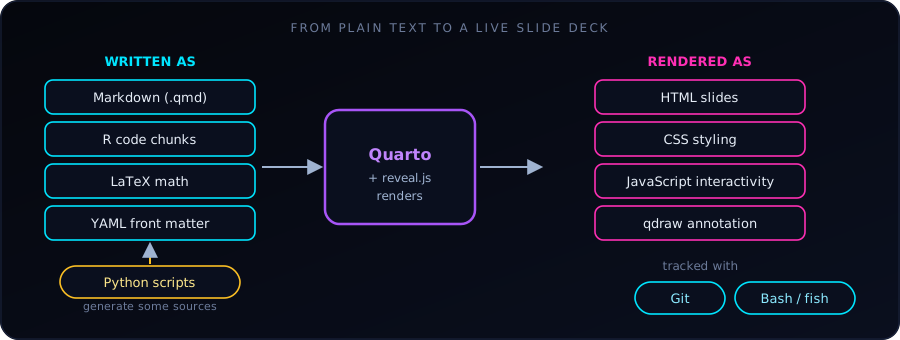
The following languages, markup formats, and tools go into building each presentation:
- HTML (HyperText Markup Language): the standard markup language for web pages. The output files are HTML, generated mainly from
.qmdsources, though raw HTML is occasionally used directly. - CSS (Cascading Style Sheets): the stylesheet language behind the site’s design, heavily customized to match Stat Mania’s look.
- JavaScript: powers the slides’ interactivity, both for dynamic content loading and as part of the HTML output that
revealjsgenerates. - R: used for data generation and computation inside the slides.
- Python: used in scripts that generate some of the source files (e.g. quiz banks and puzzle data).
- LaTeX: used for typesetting mathematical expressions.
- Markdown: the lightweight markup language the source files are written in.
- Git: the distributed version control system used to track every change to the source.
- Bash / fish shell: the command-line tools used for file operations and for running Quarto and Git.
- YAML (YAML Ain’t Markup Language): a human-readable format used for each slide deck’s front matter (title, date, options, and so on).
- Quarto: the publishing system that renders the
.qmdfiles into the final slides.