How to Save Loop Results in an Array in C
By the end of this lesson you will
- Fill a fixed-size array from a loop
- Grow an array with malloc and realloc
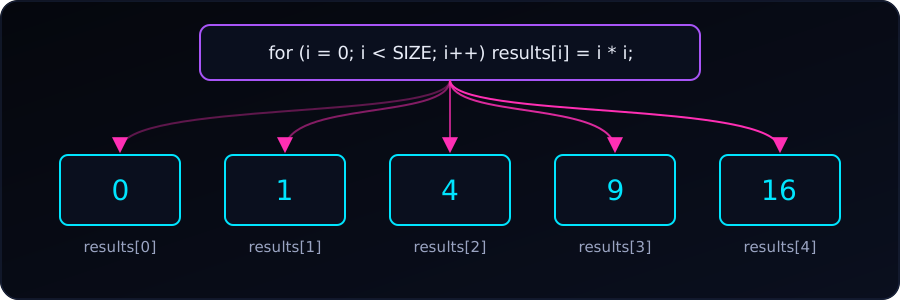
To save loop results in an array in C, we declare an array with a fixed size before the loop, then use the loop’s index variable to assign a value to each slot.
Unlike Python, a C array cannot grow with something like append(). We manage the indexing ourselves.
A fixed-size array
This program squares the numbers 0 to 4 inside a loop and stores each result:
#include <stdio.h>

#define SIZE 5   // fixed size of the array

int main(void) {
    // 1. Declare the array with a predefined size
    int results[SIZE];

    // 2. Use a loop to populate the array
    for (int i = 0; i < SIZE; i++) {
        results[i] = i * i;   // save the result at index i
    }

    // 3. Print the saved elements to check
    printf("Saved results:\n");
    for (int i = 0; i < SIZE; i++) {
        printf("results[%d] = %d\n", i, results[i]);
    }

    return 0;
}
Output (compiled with gcc -Wall -Wextra):
Saved results:
results[0] = 0
results[1] = 1
results[2] = 4
results[3] = 9
results[4] = 16Stay inside the array. Valid indices run from 0 to SIZE - 1, so the loop condition must be i < SIZE, not i <= SIZE. Writing outside the array is undefined behaviour: it may crash, or silently corrupt other variables.
When the number of values is unknown
If we do not know in advance how many times the loop will run (for example, reading numbers until the user types 0), a fixed-size array does not work. We allocate memory with malloc() and enlarge it with realloc() when it fills up:
#include <stdio.h>
#include <stdlib.h>

int main(void) {
    int capacity = 2, count = 0, x;
    int *data = malloc(capacity * sizeof *data);
    if (data == NULL) return 1;

    printf("Enter numbers (0 to stop): ");
    while (scanf("%d", &x) == 1 && x != 0) {
        if (count == capacity) {          // full: double the space
            capacity *= 2;
            int *tmp = realloc(data, capacity * sizeof *data);
            if (tmp == NULL) { free(data); return 1; }
            data = tmp;
        }
        data[count++] = x;                // save, then move to the next slot
    }

    printf("Saved %d values:", count);
    for (int i = 0; i < count; i++) printf(" %d", data[i]);
    printf("\n");

    free(data);
    return 0;
}
Entering 4 8 15 16 23 42 0 gives:
Enter numbers (0 to stop): Saved 6 values: 4 8 15 16 23 42Three habits to notice:
counttracks how many slots are used, and doubles as the next index.realloc()goes into a temporary pointer first, so we do not losedataif it fails.free()returns the memory when we are done.
Summary
| Situation | Approach |
|---|---|
| Number of iterations known | Fixed array, array[i] = value; |
| Number of iterations unknown | malloc() + realloc(), track count and capacity |
- Use the loop index to store each result:
a[i] = .... - A fixed array needs its size known up front.
mallocandreallocgrow storage at run time.
Index. A number that picks one element of an array; the first is 0.